
Origins of Pachislot Design
Pachislot is an electromechanical game that emerged in Japanese pachinko parlors in the mid-1960s. Originating as modified Western three-reel mechanical slot cabinets imported from the United States, pachislot was formally classified alongside pachinko under the regulatory framework of the Amusement Business Law (Fueiho). To preserve the legal distinction between illegal games of pure chance and permissible skill-oriented entertainment, Japanese authorities mandated specific physical and mechanical constraints that fundamentally distinguished pachislot from international slot machines. For current cabinet components, payout settings and operating cycles, see How Pachislot Machines Work.
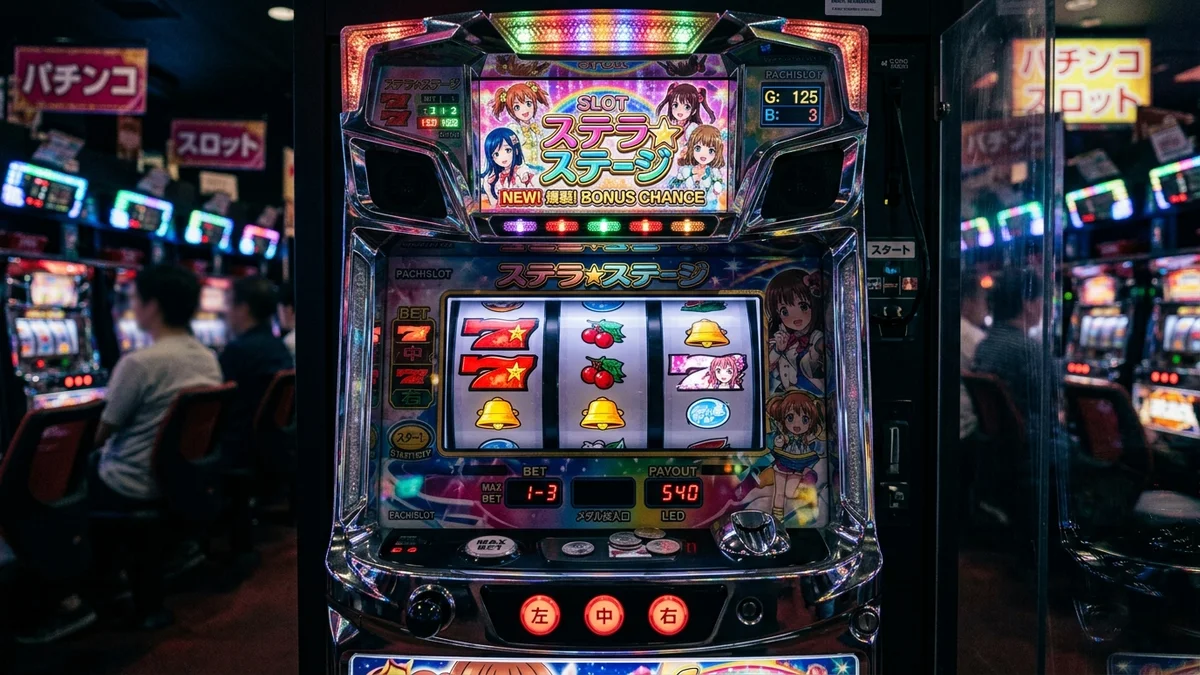
Unlike Western slots where players press a single button to initiate and stop reel rotation simultaneously, Japanese law requires three distinct physical stop buttons, known as oshi-jun buttons, positioned directly below each reel. The player must depress each button individually from left to right, right to left, or in designated operational sequences. Furthermore, the machine firmware is subject to the strict 0.19-second rule: upon player button depression, the corresponding reel must stop rotating within exactly 190 milliseconds, allowing no more than a four-symbol sliding movement, known as suberi.
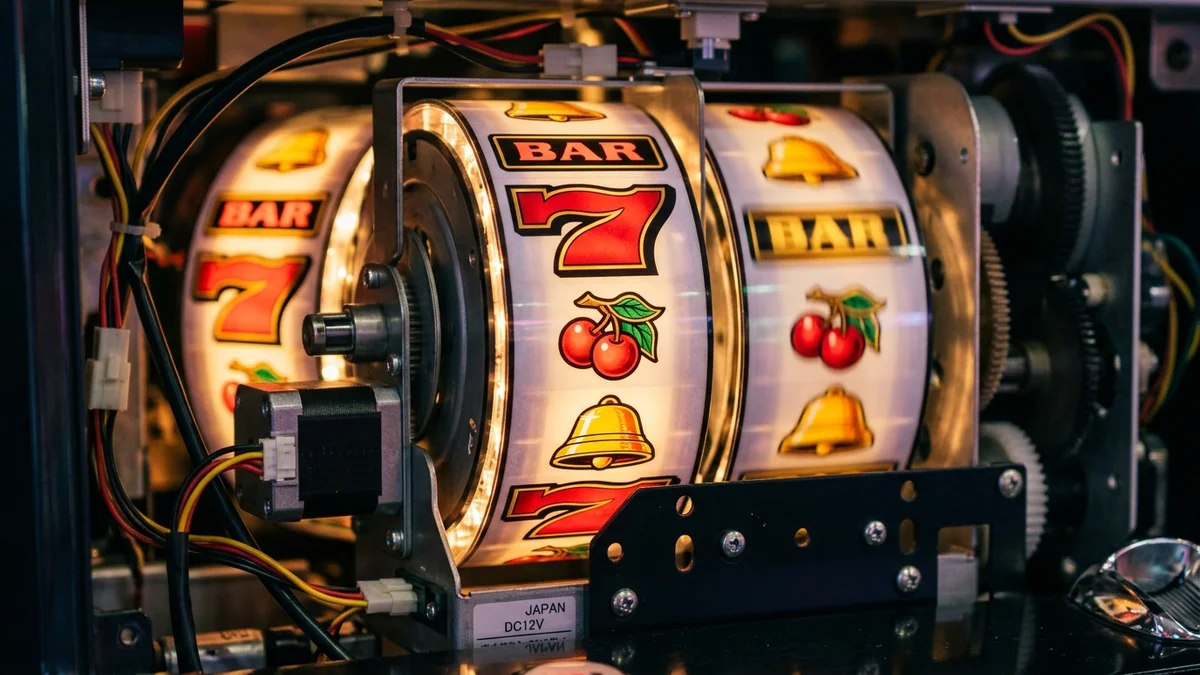
 Internal chassis of a Pachislot machine displaying precision stepper motor reel assemblies and main control board
Regulation and High-Volatility Pachislot
The mechanical and mathematical evolution of pachislot is demarcated by regulatory generations overseen by the Security Electronics and Construction Technology Association (Hodenkyo) and the National Police Agency. The industry transitioned through six distinct hardware generations, each characterized by regulatory attempts to balance player excitement with anti-addiction volatility caps.
| Machine Generation | Operational Period | Key Mechanical Innovations | Payout Characteristics |
|---|---|---|---|
| Unit 4 | 1992 - 2004 | Stock Time (ST) and Assist Time (AT) firmware modes | Extremely high volatility; frequent 10,000-medal sessions (Manmai) |
| Unit 5 | 2004 - 2018 | Strict payout curve testing; elimination of hidden bonus stock | Moderate volatility; introduction of RT (Replay Time) cycles |
| Unit 6 | 2018 - Present | Net payout speed capped at 2.0 to 3.0 medals/game; 2,400-medal ceiling | Controlled session ceilings; introduction of Smart Pachislot cashless cards |
The Unit 4 era represented the historical peak of machine volatility. Developers discovered innovative firmware methods to store winning bonus flags internally in electronic memory rather than paying them out immediately. Through Assist Time (AT) states, the machine used LED sub-displays or voice commands to tell the player the exact order in which to press the three stop buttons, bypassing the physical symbol alignment barrier and releasing thousands of accumulated medals in rapid succession.
 Upper LCD screen displaying character battle sequences that determine bonus multiplier outcomes
During Unit 4 operation, machines routinely generated payout runs exceeding 10,000 medals, known as Manmai, representing a net prize value of approximately 200,000 yen within a three-hour window. This intense volatility prompted the National Police Agency to mandate comprehensive redesigns in 2004 under Unit 5 regulations, requiring strict mathematical payout curve testing that prohibited hidden bonus stock mechanics and forced developers to innovate through complex sub-screen video narratives.
Reel Freezes and Anticipation
To heighten emotional engagement within strict regulatory payout limits, Japanese pachislot engineers developed elaborate audiovisual dramaturgy. Chief among these innovations is the reel freeze, known in Japanese parlor vernacular as furi-zu. During a freeze event, the physical reels lock mechanically in place upon coin insertion or lever pull, accompanied by sudden blackout of all cabinet illumination and dramatic silence from the speaker arrays.
This momentary cessation of sensory stimulation signals to the player that the internal pseudo-random number generator has struck an exceptionally rare mathematical condition, often with odds exceeding 1 in 32,000 or 1 in 65,000. Following the silent pause, the cabinet erupts into high-intensity strobe lighting and anime battle cutscenes, confirming entry into the machine's maximum payout bonus mode. This precise choreography of sensory deprivation followed by explosive audiovisual stimulation established a pacing template that modern digital game designers study extensively.
From Pachislot Cabinets to Online Slots
As the international online gaming sector matured throughout the 2010s, European and Asian digital slot studios began deconstructing Japanese pachislot mechanics to diversify their game portfolios beyond traditional Western five-reel layouts. Pioneered by specialized development studios such as Japan Technicals Games (JTG) and Golden Hero, a new sub-genre of mobile online slots directly imported the aesthetic, auditory, and mathematical logic of Japanese pachislot into web browsers.
 Modern mobile slot layout incorporating 3x3 Japanese pachislot reels and sequential respin counters
Titles such as Hawaiian Dream and Battle Dwarf abandoned standard multi-payline video structures in favor of compact 3x3 grid matrices, high-energy soundtrack transitions, and chained re-spin loops. In these games, landing specific scatter symbols triggers sequential re-spins where cabinet lighting shifts through four color tiers—blue, green, purple, and red—before bursting into continuous free-spin bonus modes, mimicking the physical lighting transitions of Tokyo parlor cabinets.
Skill-Stop Perception and Player Behavior
The lasting contribution of Japanese pachislot to international electronic game design lies in the psychological balance between perceived player control and underlying mathematical probability. While the internal electronic micro-controller determines the maximum legal payout potential via certified random number algorithms, the physical presence of stop buttons and the 0.19-second delay gave generations of players the conviction that physical timing directly influenced monetary results.
In modern digital slots, this legacy persists through interactive feature-buy triggers, multi-tiered gamble ladders, and interactive pick-and-win bonus stages. By anchoring abstract mathematical odds in kinetic player actions and dramatic narrative pacing, the engineering innovations born from Japanese regulatory restrictions continue to reshape electronic gaming interfaces worldwide.
The evolution from mechanical lever-pulled boxes to digital 3x3 mobile engines illustrates how statutory constraints drive mechanical ingenuity, establishing an enduring design philosophy where rhythm, narrative tension, and audiovisual choreography take precedence over simple random outcomes.
In contemporary gaming laboratories across Tokyo and Yokohama, mathematical engineers continue to refine assist replay state transitions. By calculating complex permutations of symbol reel stops across three independent stepper motors, designers ensure that even during regulatory net payout caps of 2.0 medals per spin, the psychological engagement curve remains elevated. Pachislot mechanics have since appeared in Japanese amusement games and some digital slot designs.