
Historical Lineage of Korean Wagering Pastimes
Traditional games of chance in Korea have a long history, from agricultural rituals and court pastimes to public festivals. During the Three Kingdoms period and the subsequent Goryeo Dynasty, ancestral games served dual functions as seasonal divination rites and recreational diversions. Communal wagering during major lunar milestones, particularly Seollal (Lunar New Year) and Chuseok (Harvest Moon Festival), was deeply woven into village celebrations.
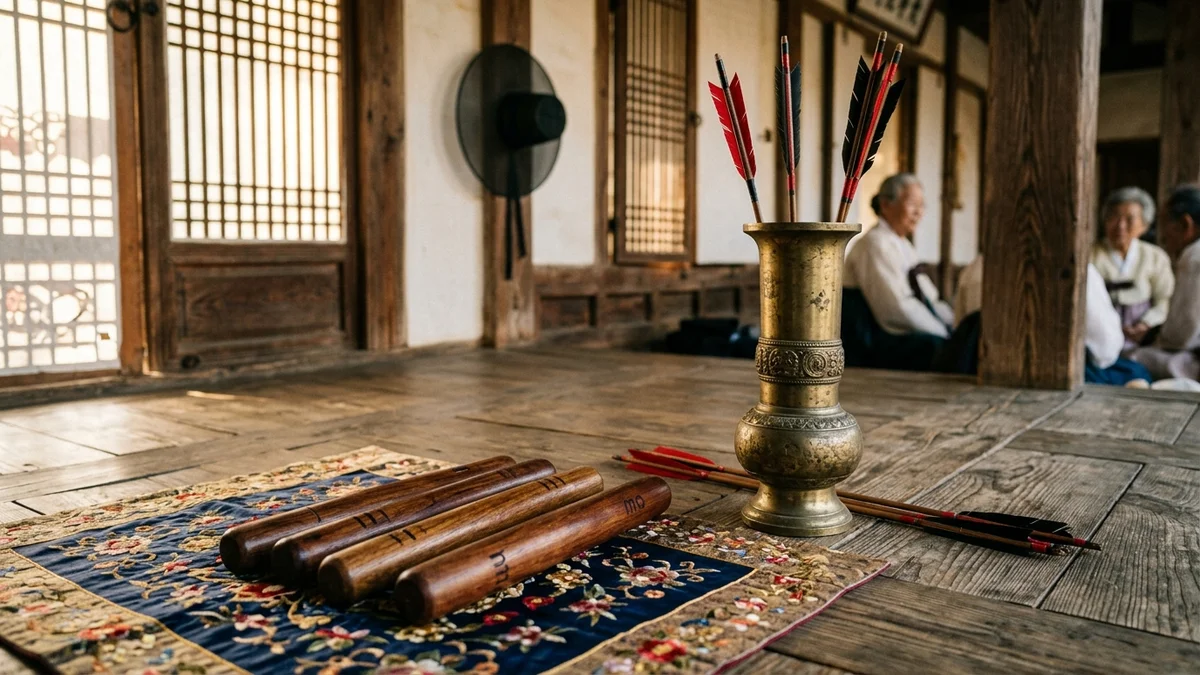
Among the oldest recorded pastimes is Tuho, or pitch-pot, introduced from Tang Dynasty China and practiced extensively among the Joseon Dynasty yangban nobility. Tuho required participants to throw polished arrow-like sticks into a narrow brass vessel placed at a fixed distance. While celebrated as an exercise in moral etiquette, historical annals record substantial private wagering among aristocratic households on match results. In parallel, commoners developed folk dice games, most notably Ssangnyuk (Korean tables), utilizing double bone dice and wooden tokens on marked boards, with village stakes placed on rapid board clearance.
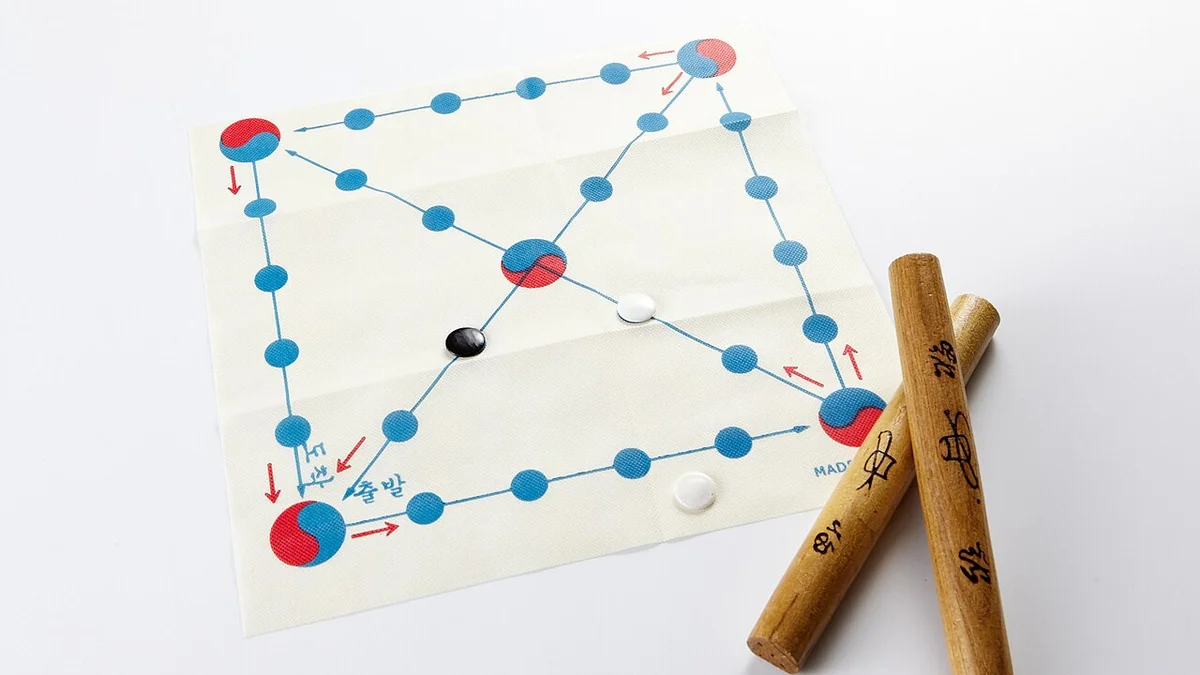
 Traditional Yutnori wooden casting sticks (yut-garak) and embroidered cloth playing board (malpan)
The Mathematical Architecture of Yutnori
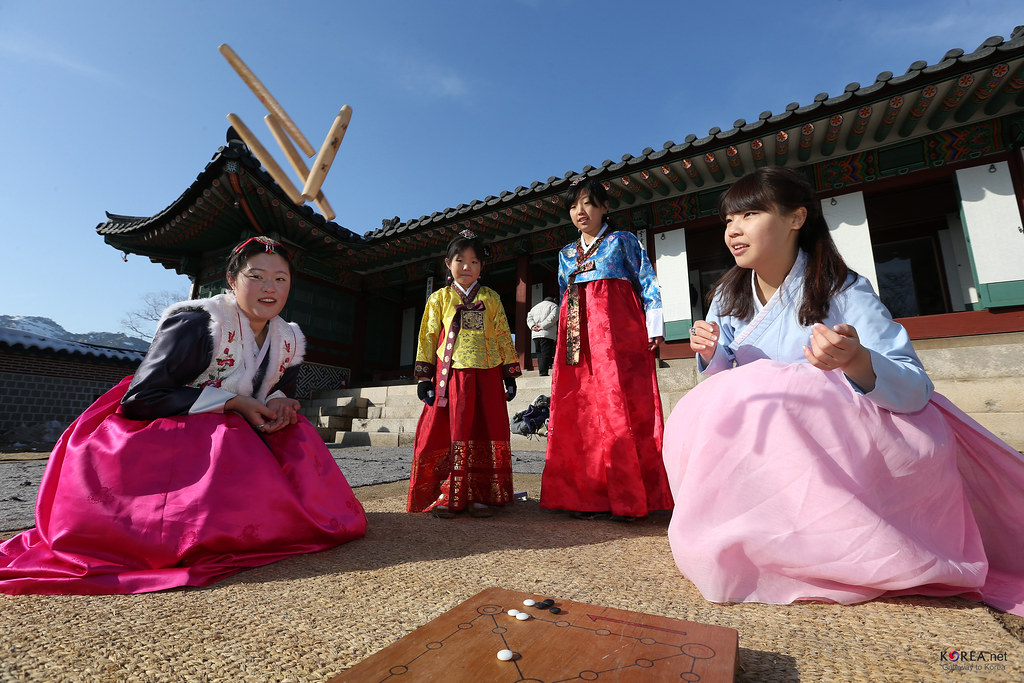
Yutnori represents the quintessential traditional Korean game of chance, combining physical casting physics with strategic token movement across a 29-station circular matrix known as the malpan. The game utilizes four wooden sticks, called yut-garak, crafted from seasoned chestnut or birch wood. Each stick features one flat surface and one convex round surface. Players cast the four sticks into the air, with the outcome determined by the combination of flat and round faces resting upward.
| Outcome Designation | Flat Faces Up | Theoretical Probability | Board Movement Allocation |
|---|---|---|---|
| Do | 1 Flat, 3 Round | 25.0% (4/16) | 1 Step Forward |
| Gae | 2 Flat, 2 Round | 37.5% (6/16) | 2 Steps Forward |
| Geol | 3 Flat, 1 Round | 25.0% (4/16) | 3 Steps Forward |
| Yut | 4 Flat, 0 Round | 6.25% (1/16) | 4 Steps Forward + Extra Cast |
| Mo | 0 Flat, 4 Round | 6.25% (1/16) | 5 Steps Forward + Extra Cast |
While theoretical binomial probability assumes an even 50% distribution per stick, physical casting dynamics reveal that the convex curvature and center of gravity of traditional yut-garak result in flat faces landing upward approximately 58% to 62% of the time. This mechanical asymmetry alters practical odds, making Gae (two flat faces) occur at frequencies exceeding 42% on traditional straw mats. Strategic depth emerges from selecting navigation routes along four diagonal intersections across the malpan, balancing risk against token-capturing mechanics.
 Traditional yut-garak casting on woven straw mat showing convex and flat face distributions
When a player casts Yut or Mo, they gain an additional cast, creating compound turns that enable rapid token advancement or the capture of opponent markers. Capturing an opponent's marker sends it back to the starting threshold, altering the probability curve of winning and introducing aggressive tactical blocking strategies that distinguish competitive village play.
The Importation and Transformation of Hwatu
In the late 19th century, Japanese merchants operating in port cities such as Busan and Incheon introduced Hanafuda (flower cards) to the Korean peninsula. Known domestically as Hwatu, literally flower fight, the 48-card deck rapidly superseded traditional bone and bamboo dominoes (Golpae) and ancestral card sets (Tujeon). Korean players systematically adapted the deck, establishing distinct scoring rules and tactical conventions that culminated in the creation of Go-Stop.
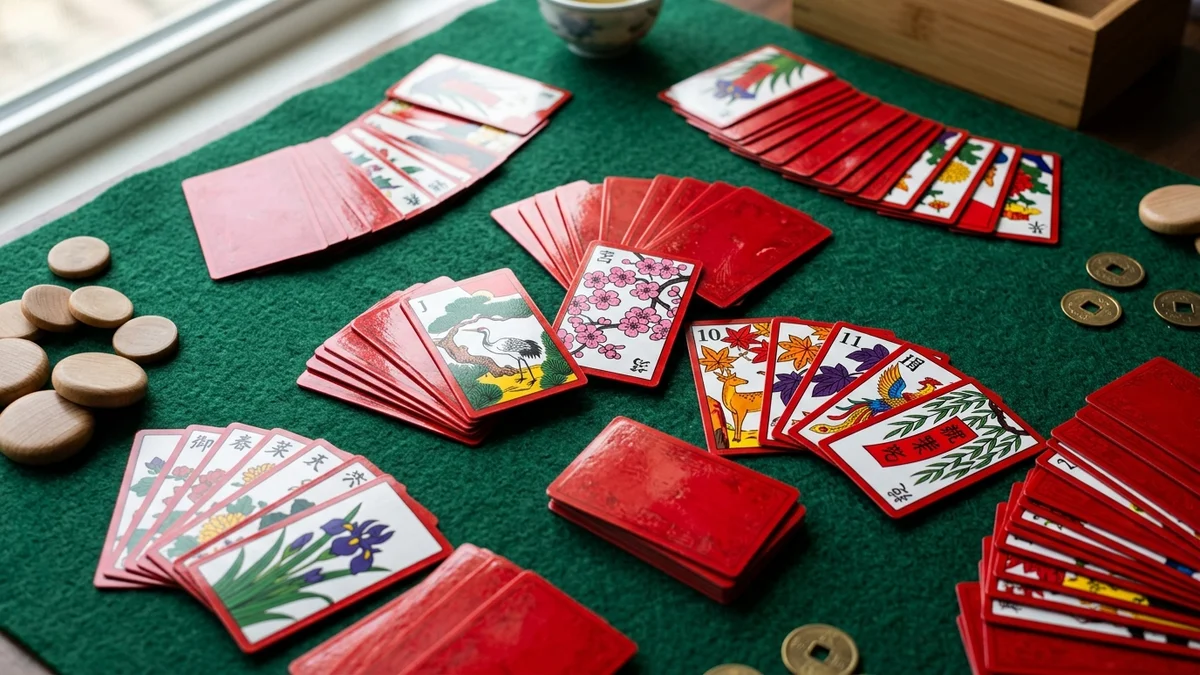
Hwatu consists of twelve suits of four cards each, with each suit corresponding to a specific month of the lunar year and represented by characteristic flora and fauna: Pine (January), Plum Blossom (February), Cherry Blossom (March), Wisteria (April), Iris (May), Peony (June), Bush Clover (July), Susuki Grass (August), Chrysanthemum (September), Maple (October), Willow (November), and Paulownia (December). Unlike Japanese Hanafuda games like Koi-Koi, Korean Go-Stop incorporates aggressive point-multiplier rules that dramatically heighten financial swings.
Operational Dynamics of Go-Stop
Go-Stop is typically contested by three active players, with surplus participants sitting out as non-playing observers known as gwangpali. Points are calculated through capturing cards from the central pool matching the month suit of cards played from hand. Specialized card groupings yield point multipliers: Bright cards (Gwang), Ribbon cards (Tti), Animal cards (Yeolkkut), and basic Junk cards (Pi).
 Hwatu cards arranged on playing felt during a competitive match of three-player Go-Stop
Upon achieving the minimum scoring threshold—three points in three-player configurations or seven points in two-player variants—the leading player must declare either Stop to claim the accumulated stakes or Go to continue the round in pursuit of compounding multipliers. Declaring Go introduces severe financial jeopardy: if another participant scores before the caller increases their tally, the caller incurs Dokbak, assuming total liability for all player debts. Additional multiplier mechanics, including Shake (holding three identical suit cards), Ppuk (losing played cards to the pool), and Pi-bak (insufficient junk cards), compound payouts geometrically.
Yutnori and Go-Stop can be played socially or for stakes; legal treatment depends on the circumstances. This article focuses on the games and their cultural context. For the statutory rules and the court's "momentary amusement" test, see Gambling Laws in South Korea.