
The Deep Ancestry of Asian Wagering Customs
Traditional games of chance developed across East, Southeast and South Asia long before electronic gaming machines appeared. Rooted in imperial court divination, seasonal harvest celebrations, and maritime mercantile trade, these pastimes combined simple tactile instruments—such as carved cowrie shells, wooden sticks, polished bone dominoes, and brass buttons—with sophisticated mathematical probability systems.
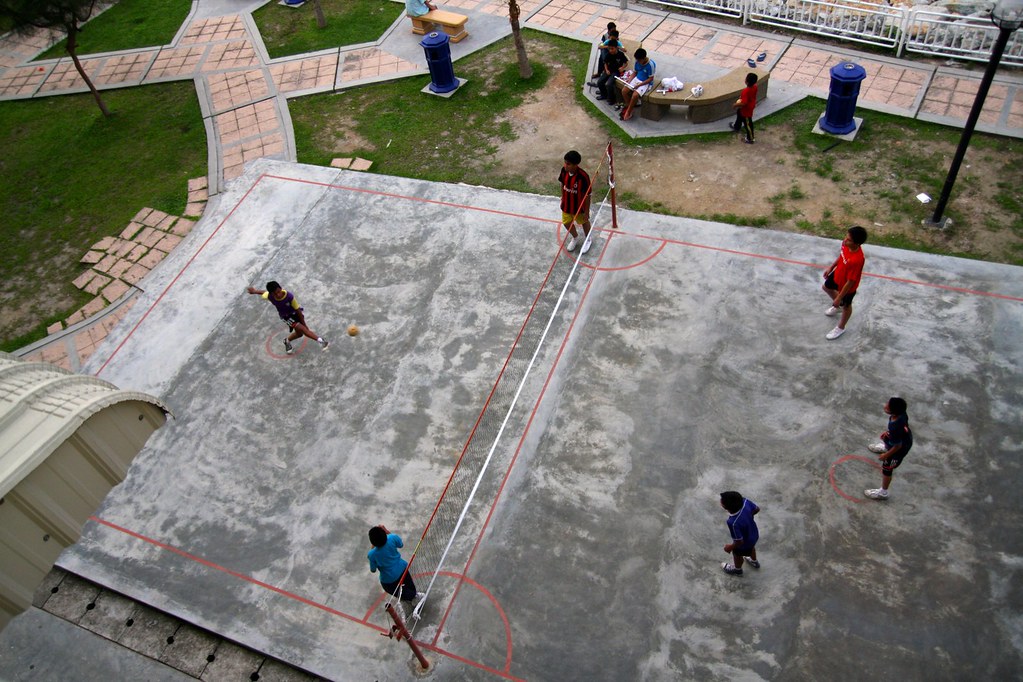
In the bustling merchant ports of the Pearl River Delta, the tea trade hubs of the Yangtze basin, and the riverine kingdoms of Southeast Asia, traditional wagering games served vital social functions. They facilitated wealth redistribution during festival seasons, cemented alliances between trading merchant guilds, and provided community entertainment in urban public squares and village gathering halls.
 Traditional Fan-Tan arrangement showing the central button pile, brass cup, and ivory counting wand
The Mechanical Simplicity of Fan-Tan
Among the oldest and most enduring Asian table games is Fan-Tan, a game of pure mathematical division that dominated commercial gambling houses throughout southern China, Macau, and nineteenth-century overseas Chinatowns. The operational mechanics of Fan-Tan require no dice, cards, or complicated mechanical hardware. The game is conducted using a pile of several hundred small brass buttons, porcelain beads, or polished glass counters placed upon the center of a table.
The dealer, known as the Tan-Kun, places a large brass cup over an arbitrary portion of the pile, isolating a random subset of counters. Players place wagers on a square board numbered 1, 2, 3, and 4. The dealer then lifts the cup and uses a slender ivory or bamboo wand to systematically remove the counters in groups of four. The game outcome is determined solely by the number of counters remaining in the final group: one, two, three, or four.
| Traditional Game | Primary Wagering Medium | Mathematical Architecture | Primary Geographic Hub |
|---|---|---|---|
| Fan-Tan | Brass buttons and bamboo wand | Modulo 4 arithmetic division | Guangdong, Macau, Hong Kong |
| Sic Bo (Tai Sai) | Three six-sided dice in sealed shaker | Combinatorial permutations (3 to 18) | China, Macau, Philippines |
| Pai Gow | 32 carved bone/wood domino tiles | Two-hand hierarchical ranking pairs | Southern China, Macau, Las Vegas |
| Bầu Cua Tôm Cá | Three dice with animal illustrations | Multinomial image matching (6 symbols) | Vietnam, Lunar New Year festival circuits |
With an exact 25% theoretical probability for each outcome, Fan-Tan provided absolute transparency. Because players could visibly watch the dealer count down the button pile four by four with the wand, the game earned a reputation for being nearly impossible to rig, making it the bedrock of Macau's early commercial casino monopolies under the nineteenth-century Batata concessionaires.
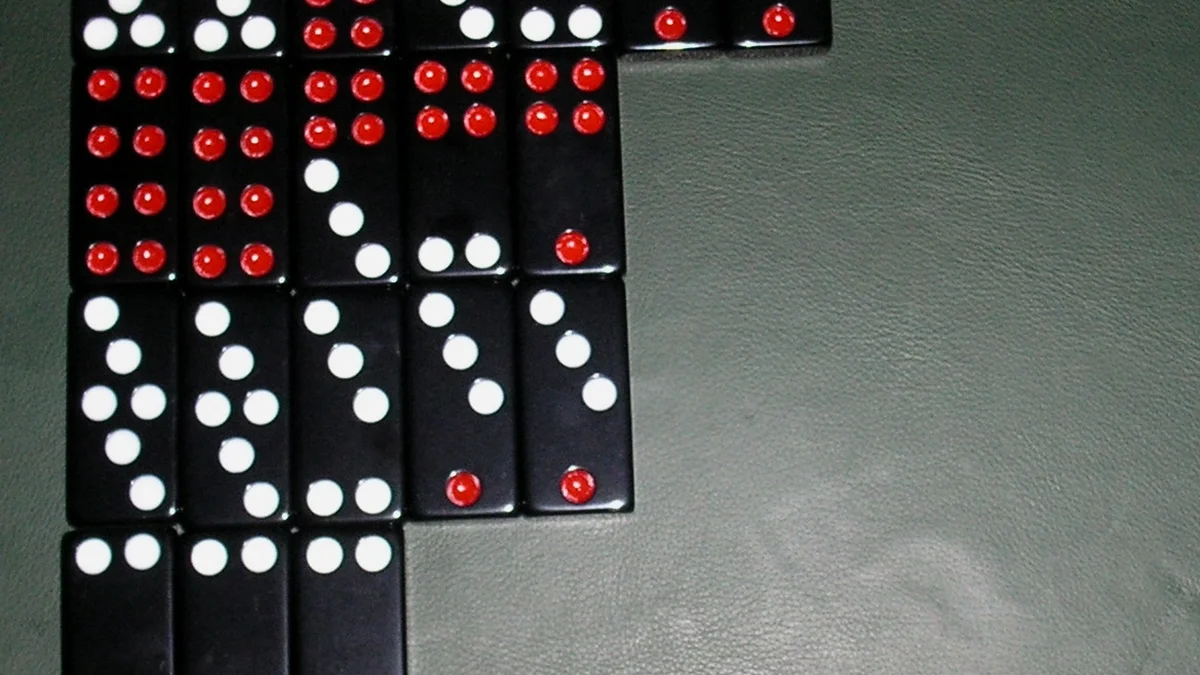 Traditional Pai Gow 32-tile domino set showing the Supreme pair (Gee Joon) and high civil rankings
Sic Bo and the Mechanics of the Shaken Dome
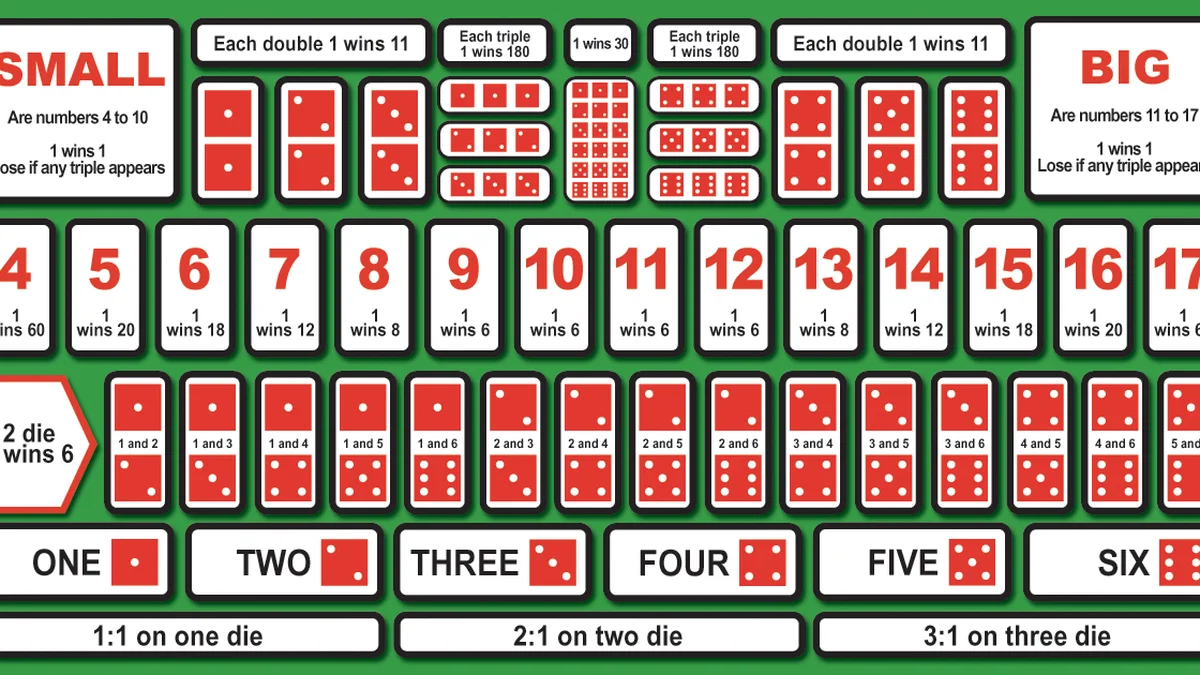
Sic Bo, known alternatively as Tai Sai (Big-Small) or Dai Siu, represents China's ancient contribution to global dice wagering. Dating back to the Han Dynasty, Sic Bo utilizes three standard six-sided dice. In traditional street play, the dice were shaken in an unglazed ceramic bowl covered by a heavy earthenware saucer. In modern Macau casinos, the game utilizes a sealed mechanical vibrating dome to ensure total randomness and prevent magnetic dice manipulation.
Players wager on a complex table felt offering dozens of mathematical combinations. The core wagers are Big (totals 11 through 17) and Small (totals 4 through 10), each paying even money (1 to 1) with the house advantage secured by the rule that all specific triples (e.g. three 4s) result in a player loss. Specific triple bets offer high payouts up to 180 to 1, creating a volatile balance between steady even-money bets and high-multiplier longshots.
Pai Gow Dominoes and Strategic Hand Division
Pai Gow, literally make nine, is played with a specialized set of thirty-two carved bone or wooden Chinese dominoes. Unlike Western dominoes based on simple numerical sequences, Pai Gow tiles are categorized into two asymmetrical hierarchies: Civil tiles (Wen) and Military tiles (Wu), reflecting the bureaucratic and military command structures of imperial Chinese governance.
 Illuminated mechanical Sic Bo vibrating dome installed on a contemporary Asian casino floor
Each participant receives four tiles and must separate them into two distinct hands of two tiles each: a front hand (low hand) and a back hand (high hand). To win, both of the player's hands must beat the corresponding hands of the banker. Hand rankings rely on complex historical pairs—headed by the Gee Joon (Supreme pair)—followed by point values calculated modulo ten. The strategic challenge lies in setting the tiles to balance both hands, demanding deep probabilistic calculation under pressure.
Bầu Cua Tôm Cá in Southeast Asia
In Southeast Asia, folk wagering traditions adapted regional maritime and agricultural symbolism. In Vietnam, the traditional holiday game of Bầu Cua Tôm Cá (Gourd-Crab-Shrimp-Fish) is contested during Tết (Lunar New Year) celebrations. The game utilizes three six-sided dice marked not with numbers, but with animal figures: Gourd, Crab, Fish, Rooster, Shrimp, and Deer.
Players place wagers on a matching cloth board. When the dice are revealed from beneath an earthenware bowl, payouts correspond to the frequency of the chosen animal appearing, mirroring the mechanics of the British colonial naval game Crown and Anchor. Similar variants flourish across the region, including Hoo Hey How in southern China and Keno-like street number draws across the Mekong basin.
These traditional games of chance reflect centuries of Asian mathematical ingenuity. Characterized by tactile physical apparatuses, transparent mechanics, and elegant probabilistic rules, they laid the cultural and psychological foundation upon which Asia's multi-billion-dollar modern gaming and casino resort industries were subsequently constructed.
The historical significance of Fan-Tan in southern China was underscored by its role in financing nineteenth-century colonial municipal budgets. In 1849, the Portuguese colonial administration in Macau formally licensed Fan-Tan gambling houses to generate public revenue, granting exclusive monopoly concessions to wealthy merchant syndicates. The game's absolute operational transparency—where every spectator could witness the physical counting of the button pile—fostered immense public trust that resisted foreign roulette or card games for generations.
Similarly, the combinatorial structure of Pai Gow dominoes reflects deep traditional East Asian mathematical philosophy. Evaluating thirty-two tiles across sixteen asymmetric paired hierarchies demands continuous probability assessment under time constraints. Professional players calculate the distribution of remaining high tiles—such as the Teen (Heaven, 12 pips) and Day (Earth, 2 pips)—balancing the front hand's requirement to remain lower than the back hand while maximizing the overall probability of defeating the banker's two split hands.