
Japan's Penal Code Gambling Ban
Japan's gambling laws are set out in Chapter 23 of the Penal Code (Keihou), enacted in 1907 during the Meiji era. Article 185 establishes a general criminal prohibition against gambling, providing that any person who wagers property or money shall be punished by a fine of up to 500,000 yen or a petty fine. The statute incorporates a narrow proviso exempting acts committed for temporary entertainment (ichiji no goraku no kyousuru mono), historically interpreted by the judiciary as small-value items immediately consumed on the premises, such as meals or beverages.
Article 186 imposes substantially more severe criminal penalties for aggravated offenses. Paragraph 1 establishes the crime of habitual gambling (joushu tobaku), punishing repeat offenders with imprisonment with labor for up to three years. Paragraph 2 criminalizes the operation of a gambling premises for financial profit (tobakujou kaisetsu), imposing prison sentences of between three months and five years on operators, floor managers, and bookmakers.
 Statutory text of the Japanese Penal Code establishing general criminal prohibitions against gambling
Public Sports and Koei Kyogi
To generate public revenue for post-war municipal reconstruction and industrial modernization, the Japanese Diet enacted specific statutory exceptions to the Penal Code, establishing four state-sanctioned Public Sports categories, known collectively as Koei Kyogi. Each category operates under dedicated national legislation and is supervised by a specific central government ministry.
| Public Sports Category | Governing Statute | Supervising Central Ministry | Statutory Fund Allocation |
|---|---|---|---|
| Horse Racing (Keiba) | Horse Racing Act (1948) | Ministry of Agriculture, Forestry and Fisheries | Livestock promotion, national treasury contributions |
| Bicycle Racing (Keirin) | Bicycle Racing Act (1948) | Ministry of Economy, Trade and Industry (METI) | Mechanical industry subsidies, disaster reconstruction |
| Speedboat Racing (Kyotei) | Motorboat Racing Act (1951) | Ministry of Land, Infrastructure, Transport (MLIT) | Maritime safety, shipbuilding, municipal welfare funds |
| Auto Motorcycle Racing (Auto Race) | Small Vehicle Racing Act (1950) | Ministry of Economy, Trade and Industry (METI) | Automotive engineering and municipal municipal development |
In addition to Koei Kyogi, the Sports Promotion Lottery (toto) operates under specialized legislation enacted in 1998, supervised by the Ministry of Education, Culture, Sports, Science and Technology (MEXT). Revenues fund national sports facilities and elite athlete training programs. These public betting monopolies operate through government-licensed totalizator systems where the house extracts a statutory retention deduction of between twenty-five and thirty percent before redistributing pooled wagers to winning ticket holders.
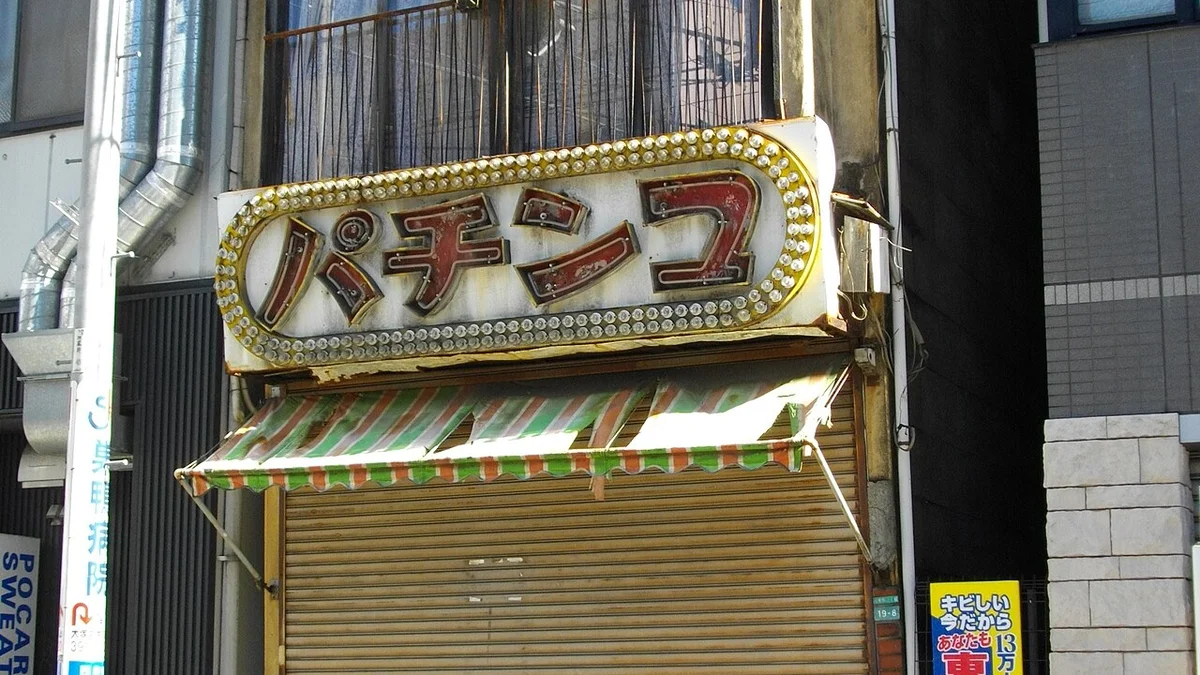 Pachinko parlor operating license notice issued by the Prefectural Public Safety Commission under the Fueiho Act
Amusement Business Law and Pachinko
The multi-billion-dollar pachinko and pachislot industry occupies a unique statutory position within Japanese administrative law. Rather than being classified as a gambling enterprise, pachinko is licensed and regulated under the Act on Control and Improvement of Amusement Business (Fueiho). Specifically, parlors operate as Category 4 adult amusement centers, supervised directly by Prefectural Public Safety Commissions and local police departments.
Article 23 of the Fueiho Act strictly prohibits pachinko parlors from awarding cash or securities as prizes, buying back awarded prizes from players, or providing prizes that can be readily exchanged for cash on the parlor premises. To comply with these statutory boundaries, the industry developed the Three-Shop System (San-ten Hoshiki). Under this tripartite legal architecture, the parlor, the independent prize buyer, and the wholesale distributor remain legally and operationally separate entities, preserving the technical legality of the trade.
2018 Integrated Resort Act
The definitive modernization of Japanese gambling law occurred in July 2018 with the passage of the Act on Development of Specified Complex Tourist Facilities Areas (IR Implementation Act). This landmark statute created a legal exception to Penal Code Article 185, formally authorizing the licensing of up to three commercial casino resorts embedded within large-scale international tourism complexes.
 Entrance to the Japan Casino Regulatory Commission established as an independent oversight authority
The IR Implementation Act created the Japan Casino Regulatory Commission (JCRC) as an independent regulatory agency with comprehensive licensing, investigative, and enforcement powers. The law imposes strict operating parameters: casino floor space cannot exceed 3% of total resort gross floor area, gaming revenue is taxed at an effective rate of 30% (shared equally between national and local governments), and domestic residents face a 6,000 yen entrance fee and visit frequency caps enforced via My Number biometric verification.
Japan's Ban on Offshore Online Betting
A critical contemporary focus of Japanese law enforcement is the eradication of illegal online casino wagering. Japanese police authorities and the Ministry of Justice maintain that Penal Code Article 185 applies fully to domestic residents who access foreign-licensed online casino websites from within Japan.
Under the principle of territorial jurisdiction codified in Penal Code Article 1, an offense is considered committed within Japan if any element of the act—including placing the digital wager or receiving funds—occurs domestically. Police departments across Japan actively prosecute domestic online bettors, targeting payment processor intermediaries and domestic marketing affiliates that promote offshore gaming portals. This active enforcement reinforces the state's longstanding policy: gambling remains strictly illegal unless explicitly authorized by dedicated statutory acts of the Diet.
Administrative supervision of the pachinko industry is enforced through unannounced police inspections conducted by Prefectural Public Safety Commissions. Municipal police officers inspect parlor machine motherboards with specialized electronic testing devices, verifying that internal ROM chips bear intact serialized security seals and match certified Hodenkyo firmware checksums. Parlors caught operating modified ROMs face immediate license revocation and criminal referral under Fueiho statutes.
In the integrated resort sector, the Japan Casino Regulatory Commission enforces unprecedented continuous compliance monitoring. The commission maintains dedicated on-site offices within future resort properties, exercising statutory authority to inspect casino accounting ledgers, review real-time CCTV surveillance feeds, and audit employee licensing credentials 24 hours a day, as part of the commission's oversight process.